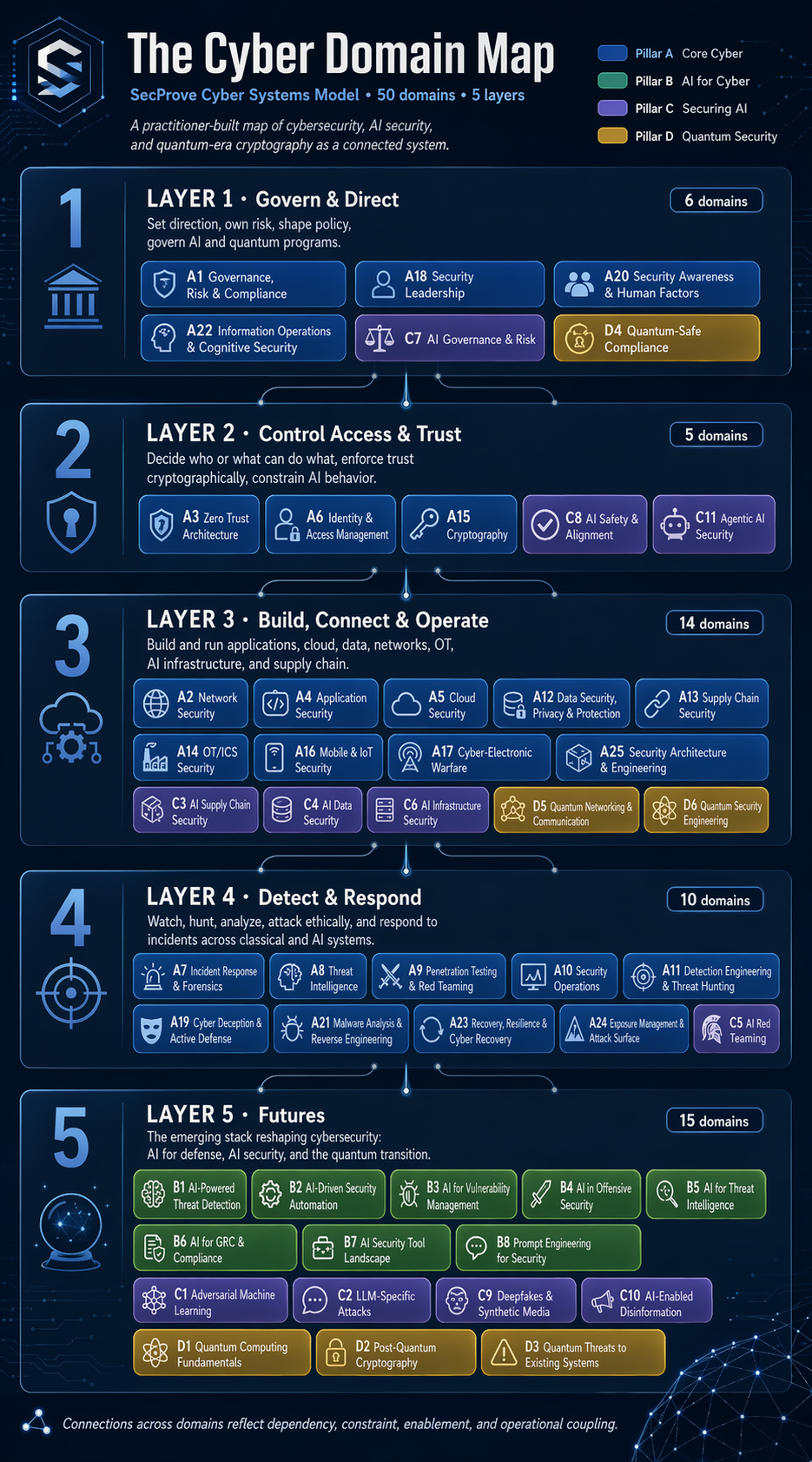
Firewalls, IDS/IPS, network segmentation, DNS security, SD-WAN, VPN, traffic analysis, wireless security.
Why it matters: The network is still where lateral movement happens. Segmentation, traffic inspection, and DNS hygiene remain load-bearing controls even in cloud-first organizations.
Common mistake: Flat internal networks behind a hardened perimeter. The first compromised endpoint then has line-of-sight to everything.
OWASP Top 10, secure SDLC, SAST/DAST/IAST, API security, code review, DevSecOps.
Why it matters: Applications are where data lives and business logic runs. The OWASP Top 10 hasn't moved much in years because the same classes of bugs keep landing in new code.
Common mistake: Treating AppSec as a gate at the end of the SDLC. By then, the cheap fixes are gone.
AWS/Azure/GCP security controls, IAM policies, CSPM, container security, shared responsibility model.
Why it matters: Cloud is now the default deployment target. Misconfigurations — not novel exploits — remain the leading cause of cloud breaches because the shared-responsibility line is easy to misread.
Common mistake: Defaulting to network thinking in cloud. Most compromises start with identity and policy, not packets.
Data classification, encryption-at-rest/in-transit, DLP, tokenization, privacy-by-design, plus the regulatory stack (GDPR, CCPA, HIPAA) that sets the bar.
Why it matters: Privacy and data protection determine the fines, lawsuits, and customer trust outcomes when something goes wrong. GDPR, CCPA, and HIPAA aren't going to relax.
Common mistake: Classifying data once and never revisiting it as the product changes.
SBOM, vendor risk assessment, software supply chain attacks, dependency management.
Why it matters: SolarWinds, Log4Shell, and the MOVEit chain proved that attackers target the software and vendors you trust. Most of your CVE volume lives in transitive dependencies you didn't write.
Common mistake: Maintaining an SBOM nobody uses for prioritization. Without reachability and asset context, an SBOM is just an inventory.
SCADA, PLC security, Purdue model, ICS-specific threats, IT/OT convergence, IEC 62443.
Why it matters: OT/ICS security protects the systems that move physical things — power, water, manufacturing. A compromise here can cause physical damage and endanger lives, which changes the calculus of every defense decision.
Common mistake: Importing IT security playbooks into OT without accounting for safety, availability, and protocol fragility.
MDM, mobile app vulnerabilities, IoT protocols, firmware analysis, embedded systems security.
Why it matters: Mobile and IoT devices are the largest unmanaged attack surface in most organizations. Firmware that rarely updates, protocols not built for hostile networks.
Common mistake: Treating IoT as a procurement problem instead of a network and lifecycle problem.
Converged cyber and EW, spectrum security, GPS/GNSS spoofing, RF attacks, EMP hardening.
Why it matters: Cyber-electronic warfare is where digital attacks meet RF, GPS spoofing, and spectrum operations. Increasingly relevant for critical infrastructure and any organization with field operations.
Model provenance, dataset poisoning, Hugging Face risks, ML library vulnerabilities, trojanized models.
Why it matters: Models you didn't train and datasets you didn't curate are now in your supply chain. Backdoored models on Hugging Face, poisoned datasets, vulnerable ML libraries — same supply-chain problem, new substrate.
Training data poisoning, PII leakage from models, differential privacy, federated learning security.
Why it matters: Models memorize. Training data extraction is now a real attack. Differential privacy and federated learning are the durable answers, not after-the-fact filtering.
GPU cluster security, ML pipeline security, model serving endpoints, secrets management in ML.
Why it matters: The platforms that train and serve AI have unique security needs — multi-tenant GPU isolation, pipeline integrity, secrets in ML workflows. Traditional cloud security misses most of this.
Quantum Key Distribution, QKD limitations, QRNG, deployed quantum networks.
Why it matters: Quantum Key Distribution and QRNG offer physics-based security guarantees, with practical limitations on cost, distance, and integration. Useful for specific use cases, not a universal answer.
Quantum computer security, side-channels, quantum ML security, quantum-safe architecture.
Why it matters: Quantum security engineering is the operational work — inventorying cryptographic dependencies, designing crypto-agile architectures, and executing migration without breaking production.
Reference architectures, control frameworks (NIST SP 800-53, CIS Controls), secure-by-design patterns, threat modeling, trust-boundary design, technology standards.
Why it matters: Architecture is where identity, crypto, network, cloud, and data primitives get composed into a defensible whole. CISSP, CCSP, zero-trust literature, and cloud reference architectures all treat architecture as its own specialty — not an implicit sub-skill of AppSec or Cloud.
Common mistake: Mistaking a vendor stack for an architecture. Tools implement patterns; architecture decides which patterns to implement.
Major security product categories and vendors — EDR/XDR, SIEM, SASE/SSE, NGFW, CNAPP, IAM/PAM, SOAR, NDR, ASM, email security — what each tool does, how the major vendors compete, market consolidation, platform vs. best-of-breed trade-offs.
Why it matters: Most security work is done through products. Knowing the major categories — EDR, SIEM, SASE, CNAPP, IAM, NDR — and the handful of vendors that define each one is what makes a defender capable of reading their own stack instead of taking pitches at face value.
Common mistake: Using Magic Quadrant position as a stack-fit decision. Stack fit depends on what telemetry, identity, and policy already live in your environment — not on which vendor is in the upper-right corner of the latest analyst chart.